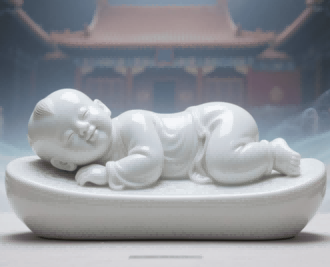
Summer afternoon, the Song Dynasty literati study, a wisp of incense, in addition to ink and paper on the table, but also lying in the shape of a baby’s porcelain pillow. The child lying on his side posture of innocence, clothing wrinkles as delicate as life, glaze warm jade – this is the Ding kiln white porcelain child pillow, a blend of practical and artistic, condensing the essence of the Song dynasty elegant culture of the heirloom. It is not only a treasure in the history of Chinese ceramics, but also the epitome of the aesthetics of ancient life.
First, Ding kiln white porcelain: the pinnacle of Song dynasty elegant porcelain representatives
As one of the “Five Famous Kilns” of the Song Dynasty, Ding Kiln is famous for its white porcelain. Located in Quyang, Hebei Province, the kiln has been known for its white porcelain since the Tang Dynasty, reaching the peak of its skill in the Song Dynasty. The uniqueness of white porcelain from the Ding kilns lies in its glaze color, which is “silver-like and snow-like”, and the texture of the body, which is “as thin as paper and as loud as a chime”. Craftsmen by improving the glaze formula and firing technology, successfully overcame the early white porcelain greenish or yellowish defects, so that the glaze presents a pure ivory white, established its status in the court and the literati class.
Ding kiln child pillow is the master of this technique. It is not simply bedding, but the Song dynasty literati pursuit of “things I am one” product. Porcelain pillow in the Song dynasty is widely popular, not only because of its cool sleep characteristics, but also because it was given the “police pillow” cultural symbolism – to remind the user to stay awake, diligent study. The modeling of the children’s pillow choice, it is implied that the “many children, many blessings,” “child naivety can get rid of evil” folk beliefs.
Second, the artistic code of the child pillow: the aesthetics of the Song dynasty in both form and spirit
Now hidden in the Palace Museum in Beijing Ding kiln white porcelain child pillow, 18.3 cm high, 30 cm long, white glaze on the whole body, the glaze glistening like jade. Its design is very ingenious: the child lying on the couch, arms folded for the pillow, feet up, head slightly sideways, look quiet with playful. The pattern of the garment is made by combining the techniques of “carving” and “scratching”, and the lines are as smooth as flowing water, which not only shows the draping feeling of silk, but also gives the static sculpture a dynamic rhythm.
The craftsmen have hidden secrets when dealing with the details:
Facial depiction: the child’s cheeks are rich and moist, his eyebrows are long and thin like the moon, and his eyes are slightly closed but with a hidden smile, perfectly uniting the contradictory senses of “sound sleep” and “animation”.
Texture: The diamond lattice pattern at the lapel and the entwined flowers at the back are not only in line with the popular patterns of fabrics in the Song Dynasty, but also enhance the three-dimensional sense through the changes in the depth of the knife.
Functional design: the pillow surface is in the shape of a Ruyi cloud head, with a slightly concave center, which is in line with ergonomics; the hollow body not only reduces the weight, but also facilitates the even distribution of heat during firing.
This style of “workmanship but not artisanal, realistic but poetic” is the embodiment of the spirit of “materialism and knowledge” in Song Dynasty art. As Song Huizong “Xuanhe painting” said: “Where in the ink and ink, to the object of Xing, is seen in the ink play.”
Third, Ding kiln technology: science and art of the Millennium Dialogue
The production of a child’s pillow, need to go through the selection of soil, billet, tire repair, glaze, firing and other more than 20 procedures. Ding kiln craftsmen created three major techniques, still admirable:
Over-firing method: the vessel will be inverted firing, greatly improving the yield, but the need to cover the unglazed awn mouth with metal inlay, but the formation of a unique “gold and silver buckle” decoration.
Flower carving technique: carve different shades of patterns on the semi-dry body with a bamboo knife, and the glaze flows under high temperature to form a “shallow relief” effect.
Fire control techniques: kiln temperature needs to be precisely controlled between 1280 ℃ – 1300 ℃, with experience to observe the flame color changes, the slightest carelessness will crack or deformation.
Archaeological findings show that the Ding kiln site in the pile of defective products, and the complete survival of the child pillow only three pieces (Beijing Palace, Taipei Imperial Palace, each hidden one, another lost overseas). This confirms the song dynasty “pottery” said: “a ware into, and tired of a hundred ware waste.”
Fourth, from bedding to cultural symbols: children’s pillows of the millennium echoes
In the eyes of the Song literati, the child pillow is not only a daily necessity, but also a carrier of emotions. Su shi had written in the “pillow inscription”: “shape fit outside no matter, the heart in the virtual since the peace”, alludes to the porcelain pillow “cool and wake up” physical properties and “cultivate the body and spirit” of the spiritual pursuit. The emergence of the baby modeling, and the Song dynasty science advocated the “heart of the child” is closely related to – Zhu Xi put forward “the existence of heavenly reason, extinguish human desire”, and the innocence of the child is just the The child’s innocence is exactly a figurative expression of the “Divine Principle”.
When we gaze at this millennium relics, not only can touch the warm glaze of the Song porcelain, but also feel the wisdom of an era on the pursuit of “technical excellence” and “art of life”. 2014, the Ding kiln white porcelain child pillow was included in the “national precious cultural relics” list, its replica of the replica, the replica of the replica of the replica of the replica of the replica of the replica of the replica of the replica of the replica. In 2014, the Ding kiln white porcelain child’s pillow was listed in the “national precious cultural relics list”, and its reproductions have become an important medium of cultural exchange between China and foreign countries. As British ceramics scholar Hobson said: “It shows the world that Oriental craftsmen have pushed functionality and aesthetics to a perfect balance as early as a thousand years ago.”