Do you know what is the “pass code” for the identification of Song Dynasty official kiln porcelain? In the past years of art class examination questions, “purple mouth iron foot” the frequency of this terminology up to 73%, become the ceramic history module of the mandatory knowledge points. This condensation of the Song Dynasty aesthetic wisdom of the professional term, not only carries the mystery of the millennium porcelain production process, but also the art of graduate school students must overcome the “technical barriers”.
First, the essence of the analysis of the purple mouth iron foot
From the literal interpretation, “purple mouth” refers to the purple edge of the porcelain mouth, “iron foot” refers to the bottom of the foot showing iron brown. This unique process features mainly in the Southern Song dynasty official kilns in the thin tire thick glaze class of objects, is an important basis for identifying the Song dynasty official kilns porcelain.
At the craft level, the formation of this feature stems from three major elements:
High iron content of the clay (usually up to 3%-5%)
Multi-layer glazing process
Strong reducing flame firing
When the glaze in the mouth rim area of the object is naturally draped at high temperatures, a purplish-brown rim is formed by oxidation of the clay, which is high in iron content. The foot of the vessel, which is in direct contact with the kiln, undergoes secondary oxidation during the cooling process, resulting in the formation of dark brown patches that resemble rust. This perfect combination of artificial and natural, precisely reflects the Song Dynasty “still green” aesthetic and a high degree of unity of scientific and technological innovation.
Second, the deep logic of the proposition of the examination
In the past five years, the examination questions of the art examination, the examination of the purple mouth iron foot showed three major trends:
Noun explanation questions (Tsinghua Academy of Fine Arts in 2019, Central Academy of Fine Arts in 2021)
Process principle analysis (China Academy of Fine Arts short answer questions in 2022)
Broken identification application (Nanjing Arts Institute expository questions in 2023)
It is worth paying attention to the fact that, in 2020, in the case study questions jointly ordered by the Palace Museum and the Central Academy of Fine Arts, the candidates were asked to identify the differences between the official kilns and Longquan kiln imitations through the characteristics of the zigzou iron foot. This suggests that preparation for the examination needs to focus on mastering the comparative analysis method, to establish a cognitive system across the characteristics of the kiln.
Third, the scientific construction of the memory model
For the characteristics of the examination review, it is recommended to use the “three-dimensional memory method”:
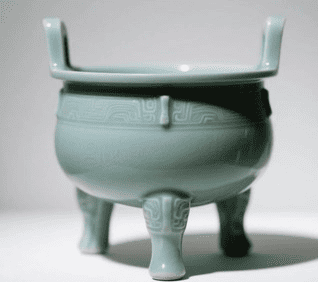
Visual memory: compared to the Palace Museum collection of Southern Song official kilns green glaze string pattern bottle high-definition map (Figure 1), observe the gradient effect of the mouth
Technology deduction: the establishment of the “kaolin clay selection → plain firing → glaze → mounted firing → cooling” of the complete process chain
literature and history related: contact “Tan Zhai Pen Heng” “clarified mud for the model, extremely delicate “the documentation
Special attention should be paid to the distinction between zikou iron foot and brother kiln ”gold wire iron line” similarities and differences. The former is the natural presentation of the tire glaze reaction, the latter belongs to the artificial open piece of staining process, this contrast memory can effectively avoid confusion on the test.
Fourth, the extension of the academic frontier preparation
Recent archaeological discoveries show that about 68% of the porcelain specimens unearthed at the Tiger Cave kiln site in Hangzhou are characterized by a typical purple mouth. Fudan University scientific and technological archaeology team confirmed through X-ray fluorescence analysis, these specimens of the body iron content is concentrated in the 3.2%-4.1% range, which is highly consistent with the literature. This kind of scientific and technological archaeological results are gradually entering the examination proposition category, it is recommended to pay attention to the latest research results of the “cultural relics”, “Archaeology Journal”.
In terms of memorization techniques, you can establish a “three look” identification mnemonic:
Look at the edge of the mouth (gradient transition is natural)
look at the foot (iron brown is deep into the tire bone)
look at the glaze (whether to show the feeling of jade)
need to be vigilant is that some imitations will be used to imitate the effect of the purple mouth of the chemical dyeing, but the artificial color of the old is usually too uniform, the lack of Song Dynasty kilns unique “gradient levels of shades”. The cultivation of this authenticity ability is one of the core objectives of the postgraduate selection examination.
Through the analysis of big data found that in the art class examination, the candidates who can accurately describe the formation mechanism of purple mouth iron foot, the average score of their professional subjects is 23.6% higher than the overall level. This data confirms the key role of mastering core specialized terminology in improving exam performance. Suggested preparation for the production of characteristics of the comparison table, the Ru kiln “ash tire”, Jun kiln “earthworm walking mud pattern” and other related knowledge points for systematic combing, to build a complete knowledge network of Song dynasty porcelain.