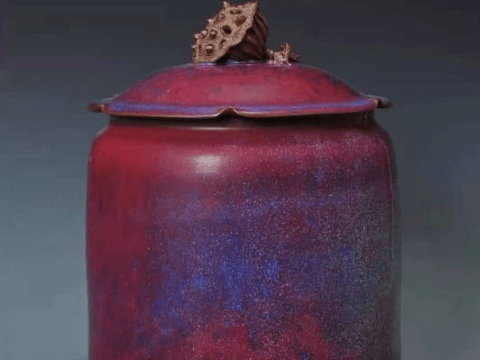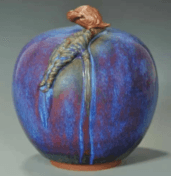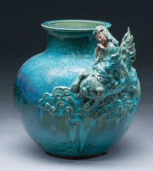
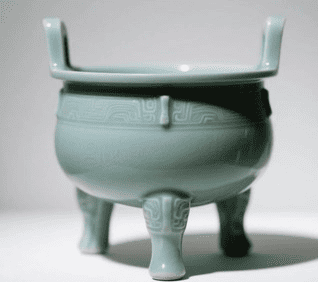
Push open the door of the Palace Museum Ceramics Museum, a green glaze sunflower petal mouth plate quietly standing in the display cabinet, glaze openings such as ice like jade, the purple-brown at the mouth edge and the foot of the iron color to form a subtle echo – this is the Song Dynasty kilns, “Purple Iron Foot” of the exemplary work. This unique technology features, not only is the ancient artisan wisdom condensation, but also the history of Chinese ceramics a key to aesthetics, carrying the Song people “Taoism and nature” philosophical pursuit.
First, the birth of the purple mouth iron foot: the perfect fusion of heavenly work and craftsmanship
At the end of the Northern Song Dynasty, Song Huizong Zhao Ji, with the poetic pursuit of “after the rain, the clouds break”, gave birth to the purest aesthetic revolution in the history of Chinese ceramics. The emergence of the purple mouth and iron foot is the very embodiment of this revolution. Artisans through the precise control of the kiln atmosphere and glaze formula, so that the porcelain mouth edge because the glaze flow and reveal the deep purple fetal bone, the bottom foot because of the high iron content and the second oxidation of iron brown, forming “the upper bearing the light of the sky, the lower ground” visual rhythm.
The realization of this process requires multiple technological breakthroughs:
Tire soil secret technology: the use of iron content of 3% -5% of the purple gold soil, after repeated washing made of “ash tire”
glaze innovation: original lime alkali glaze formula, high temperature to form a thick as congealed grease jade texture
firing control: accurately grasp the timing of the conversion of the reduction flame and oxidizing flame
According to the “Drinking Stream Zhai said porcelain,” recorded: “the official kiln character, pattern to take the ice, the texture of the ice, the texture of the ice, the texture of the ice, the texture of the ice, the texture of the ice. According to “drinking stream Zhai said porcelain” records: “official kiln character, pattern to take the ice crack eel blood on the purple mouth and iron feet, after a thousand years and the treasure light does not die.” It is this pursuit of the ultimate, so that each piece of official kiln ware become unrepeatable works of art.
Second, the spirit of Song rhyme in the aesthetic code
Under the influence of the Song Dynasty’s philosophy of “materialism and knowledge”, the purple iron foot transcends the purely technical characteristics and is sublimated into a cultural symbol. The purple color of the mouth is a metaphor for the auspiciousness of “purple energy coming from the east”, while the iron foot alludes to the Confucian concept of “carrying things in the form of virtue”, which is the same as that of the Song dynasty landscape paintings. This concept of “heavenly worker generation” is echoed by the aesthetics of Song landscape paintings, which is a cross-media echo of the aesthetics of “leftover mountains and water”.
Compared with other kilns can highlight its uniqueness:
Kiln Mouth Glaze Characteristics Aesthetic Orientation
Ru Kiln Implicit and introverted
Gao Kiln Golden threads of iron and silk
Official Kiln Iron Foot with Purple Mouth Celestial Beings
This aesthetic is still alive in contemporary design. 2023 Hangzhou Asian Games Medal “Lushan” is designed with a gradient aesthetic of the iron foot with purple mouth and a metal forging process, so that a thousand years of Song Dynasty charm and modern sportsmanship can be reflected. The design of the “Hushan” medal for the 2023 Hangzhou Asian Games incorporates the aesthetics of gradation of the purple mouth and iron feet into the metal forging process, so that the thousand-year Song charm and modern sportsmanship are reflected.
Deciphering the modern revelation of the millennium craftsmanship
With the development of scientific and technological archaeology, the mystery of Zikou Iron Foot has been gradually unraveled. X-fluorescence spectroscopy analysis shows that the purple color of the mouth edge originates from the chromatic reaction of manganese and iron elements in the tire body, while the iron color of the bottom foot is directly related to the protective glaze with an iron content of up to 8%. But what really amazes modern craftsmen is how the ancients, in the absence of precision instruments, realized micron-level glaze control based on experience alone.
Contemporary re-firing experiments have shown that:
When the iron content of the fetus is less than 2%, the purple mouth characteristics disappear
Firing temperature must be controlled in the range of 1250 ± 20 ℃
Cooling stage needs to maintain a specific oxidation environment
These data confirm the “pottery record” in the “ten kilns, nine can not be” record, but also let us more deeply understand the “craftsman’s spirit It also allows us to understand more deeply the original meaning of “craftsmanship” – not simple repetition of labor, but the wisdom of pursuing inevitability in uncertainty.
Fourth, the contemporary expression of cultural genes
In front of the kiln of Longquan celadon non-hereditary heir Chen Tangen, we see the continuation and innovation of tradition. He used the ancient formula at the same time, the introduction of 3D printing technology to make nail tools, not only to retain the ancient charm of the purple mouth and iron feet, but also to increase the yield from less than 5% to 30%. This “old art and new technology” fusion, just like the Southern Song kilns in the Northern Song dynasty based on the evolution – tradition is never a static specimen, but the flow of the river.
Digital technology is reshaping the dissemination of cultural relics:
The Palace Museum launched the “purple mouth and iron foot” AR appreciation program
Zhejiang University to build the official kiln glaze database
Blockchain technology for porcelain digital rights
When we gaze at these across the millennium of the purple-brown rim, to see is not only the miracle of craftsmanship, but also the Chinese nation “executive two with the wisdom of” – in the “two with the wisdom of When we look at these purple-brown rims that span thousands of years, we see not only the miracle of craftsmanship, but also the wisdom of the Chinese nation to “use both in the middle” – to find that delicate balance between tire and glaze, work and art, form and spirit. This balance is the most profound code of Chinese aesthetics.